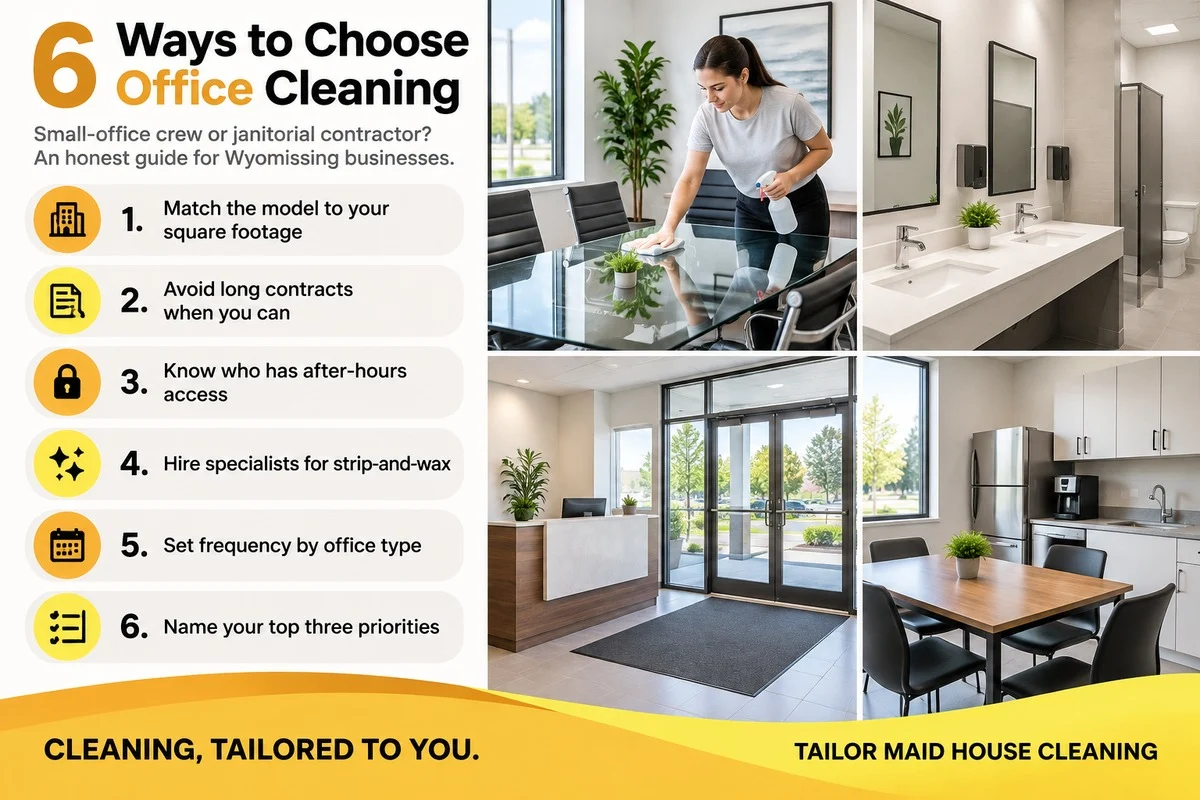
Office Cleaning vs Janitorial Service in Wyomissing
If you run a small office in Wyomissing, whether that’s a professional suite off Penn Avenue, a practice on State Hill Road or a few rooms in one of the Broadcasting Road office buildings, you’ve probably searched for “janitorial cleaning” and found two very different kinds of company. There are large commercial janitorial firms built for big buildings, and smaller office cleaning crews built for spaces like yours.
Both are legitimate, and they aren’t interchangeable. This guide compares them honestly, including the cases where a big janitorial contractor really is the better choice, so you can pick the one that fits your space, your schedule and your budget.
Janitorial Cleaning in Wyomissing: Two Different Models
“Janitorial” gets used loosely, so it helps to define the two models.
Commercial janitorial contractors
These firms specialize in large facilities: multi-tenant office buildings, warehouses, schools and medical centers. They usually work from multi-year contracts, often clean nightly, and staff each building with rotating crews. Many also handle facility maintenance such as floor stripping and waxing, carpet extraction, supply management for a whole building and sometimes light maintenance.
Small-office cleaning crews
Companies like Tailor Maid House Cleaning clean offices and small commercial spaces: professional suites, medical and dental practices, salons, studios, churches and small showrooms. The model is closer to residential service. A small, consistent team learns your space, works a written scope, and comes nightly, a few times a week, weekly or monthly, with no long-term contract.
Side-by-Side: Office Cleaning Crew vs Janitorial Contractor
Here’s how the two compare on the things that matter most to a small business.
1. Scale and fit
Janitorial contractor: built for tens of thousands of square feet and multiple floors or tenants. Small-office crew: built for a suite or a small building, where a two-person team can work through the whole space in one visit.
2. Contracts and commitment
Janitorial contractor: annual or multi-year agreements with notice periods are common. Small-office crew: our office cleaning has no long-term contract. If the service isn’t working, you shouldn’t be locked in. That flexibility suits a growing practice, or one that isn’t sure yet whether it needs weekly or twice-weekly cleaning.
3. Who actually shows up
Janitorial contractor: crews may rotate, and turnover in the commercial cleaning industry is high. Small-office crew: the same insured, background-checked team services your space each visit. In an office with confidential files, patient records or expensive equipment, knowing who has after-hours access matters.
4. Specialized floor and facility work
Janitorial contractor: this is their strength. Stripping and refinishing VCT tile, burnishing, high-rise exterior windows and building-wide carpet extraction need commercial machines and dedicated crews. Small-office crew: we cover the routine clean (desks, high-touch points, restrooms, break rooms, glass, floors) and interior and exterior window cleaning on any schedule. For a full strip-and-wax, we’ll tell you plainly that you need a floor-care specialist.
5. Communication
Janitorial contractor: you’ll typically deal with an account manager, who passes notes to a site supervisor, who passes them to the crew. Small-office crew: you talk to the owners. We’re a family business in Shillington, about ten minutes from most Wyomissing offices, and a note about the conference room table gets acted on next visit.
6. Price structure
Both models price from a walk-through. Pricing depends on square footage, number of restrooms, scope and frequency. We don’t publish a flat office rate because two 2,000-square-foot suites can be very different jobs. A dental practice with four operatories and two restrooms takes far longer than an accounting office with carpet and one restroom. After a walk-through you get a written quote, so there’s nothing to guess at.
When a Big Janitorial Contractor Is the Better Choice
We’d rather point you elsewhere than take on a job that doesn’t fit. Choose a commercial janitorial firm if:
- Your facility is large, multi-floor or multi-tenant, and needs crews in the building every night.
- You need regular floor-care programs such as stripping, waxing and burnishing as part of the contract.
- You operate a clinical or regulated environment such as a surgical suite, a lab or a facility with infection-control protocols that call for a provider trained specifically for healthcare environmental services.
- Your property manager requires one vendor for the whole building’s cleaning and supplies.
If any of these describe your space, a specialized janitorial contractor is the right call, and that’s an honest recommendation.
When a Small-Office Cleaning Crew Is the Better Choice
A small, consistent team is usually the better fit when:
- You occupy a single suite or a small building, typically a few thousand square feet.
- Clients see your space: a reception area, conference room or treatment rooms where first impressions count.
- You want a set crew you can trust with after-hours access and a key or alarm code.
- You need flexibility: weekly now, twice weekly in your busy season, no contract to renegotiate.
- You want a scope built around what matters to you, rather than a standard checklist written for a much bigger building.
What a Wyomissing Office Cleaning Visit Covers
A typical after-hours visit for a small office includes:
- Workspaces and common areas: desks and reachable surfaces dusted, high-touch points such as door handles, light switches and shared keyboards wiped and disinfected, glass and interior partitions cleaned, trash and recycling collected, carpets vacuumed and hard floors mopped.
- Restrooms: toilets, sinks, counters, mirrors and floors cleaned and sanitized, with paper and soap restocked as arranged.
- Break rooms: counters, sinks, tables, cabinet fronts, and the outside of microwaves, refrigerators and coffee machines.
- Entrances and reception: glass doors, entry mats and seating. In a Pennsylvania winter, the entry floor takes a beating from road salt, and keeping it cleaned and dry is a safety issue as much as a looks issue.
On disinfection, we follow the same principle the CDC sets out for cleaning and disinfecting facilities: clean first to remove soil, then disinfect high-touch surfaces, and leave the product wet for its full labeled contact time. Wiping a disinfectant off right away mostly just moves germs around.
How Often Should a Small Office Be Cleaned?
Frequency is where small businesses most often overspend or underspend. Here are honest starting points, adjusted after the first month based on what we see:
- Professional office with little client traffic (accountants, consultants, agencies with five to fifteen people): weekly usually holds up well, with restrooms and the break room as the main focus.
- Client-facing office (law, financial planning, real estate, insurance): twice weekly, timed so the space is at its best before your busiest client days.
- Medical, dental and therapy practices: usually several times a week to nightly, because waiting rooms, restrooms and high-touch points get heavy use from the public.
- Salons, studios and small shops: often two to three times a week. Hair, product residue and foot traffic build up quickly, and appearance is part of what you’re selling.
- Small offices used a few days a week: every other week or monthly can be enough. We’ll tell you honestly if you’re paying for more cleaning than the space needs.
Seasons matter here too. From December through March, salt and slush at the entrance often justify an extra mid-week entry and floor visit, even if the rest of the office stays on its normal schedule.
Getting the Scope Right at the Walk-Through
The walk-through is where a good office cleaning relationship starts. Have a few things ready and the quote will be accurate the first time:
- Square footage and floor types: how much is carpet, how much is tile or LVP, and whether there’s anything delicate such as natural stone in a lobby.
- Restroom count, and whether you or the building supply the paper goods and soap.
- Sensitive areas: records rooms, server closets or exam rooms you want left alone or handled a particular way.
- Access window: after 6 p.m., early morning or weekends, and how the alarm is managed.
- Your top three priorities. For most offices it’s restrooms, the entry and the break room. Naming them makes sure your budget goes where it shows.
Questions to Ask Before You Sign with Anyone
- Are your cleaners employees, and are they covered by workers’ compensation? (Ours are, and that protects you if someone gets hurt on your premises.)
- Can you provide a certificate of insurance for our landlord or property manager?
- Will the same team clean our space every visit?
- How are our keys and alarm codes stored and controlled?
- Is there a contract term or a cancellation notice period?
- Exactly what is in the written scope, and what costs extra?
- Who do I contact if something is missed, and how fast is it fixed?
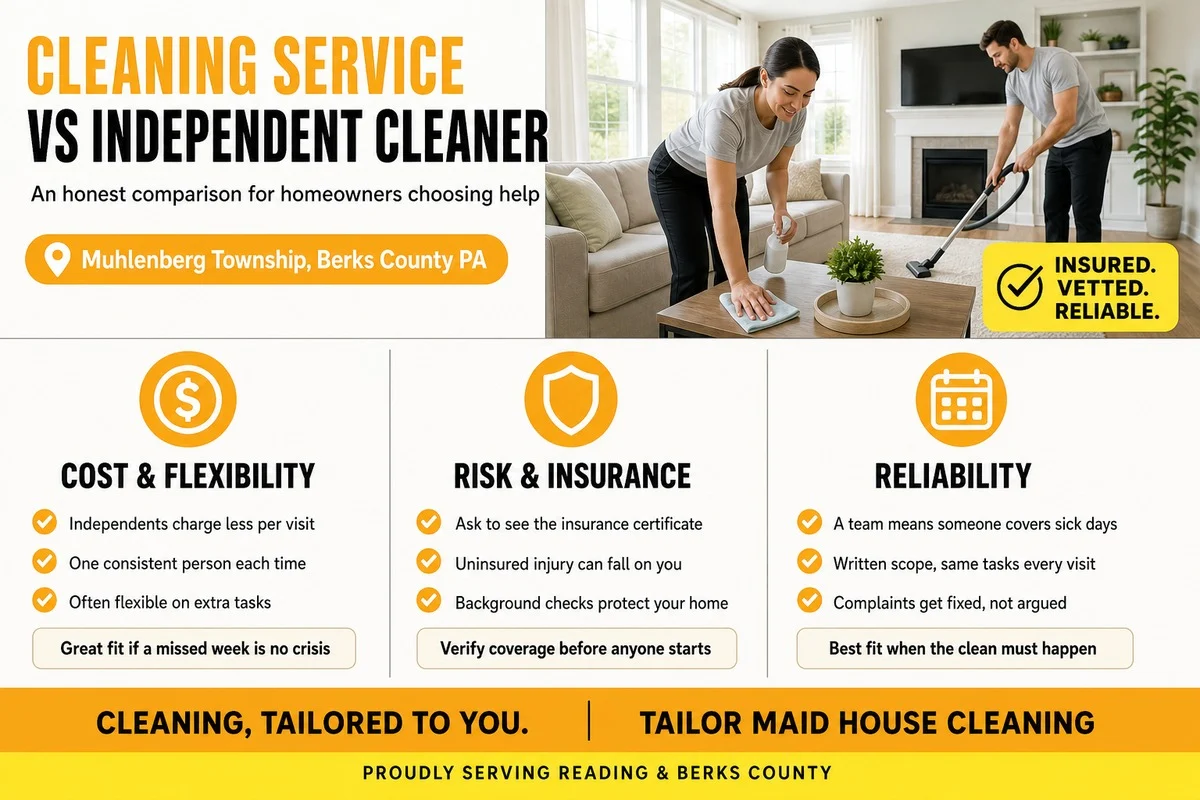
Many of these questions overlap with what homeowners should ask. Our comparison of a cleaning service vs an independent cleaner explains why employee status and insurance matter so much.
A Practical Next Step for Wyomissing Businesses
Tailor Maid House Cleaning has cleaned offices and small commercial spaces across Wyomissing, West Reading and Berks County since 2005, alongside the homes we’re best known for. If you aren’t sure which model fits your space, we’ll walk it and tell you honestly, including when the answer is “you need a bigger janitorial firm.”
Read more about our office cleaning services and our work in Wyomissing, PA, request a free estimate, or call (610) 775-4048 to schedule a walk-through.
Share this article
Related Posts

A quick overview of the topics covered in this article.