Pet Hair & Pollen: Cleaning Tips for Jacksonwald Homes
If you live in Jacksonwald, there’s a good chance you have a dog, a cat, or both. The neighborhoods off Butter Lane and Route 422, the trails around Antietam Lake, and the yards backing up toward Neversink Mountain make this a genuinely good place to be a pet owner in Exeter Township.
It also means your home is dealing with two overlapping challenges at once: pet hair and dander from the inside, and Berks County’s serious pollen and outdoor allergen load coming in from the outside — much of it riding in on the dog. Late summer is peak season for the second part, because ragweed pollen starts in mid-August and runs until the first hard frost, and mold spores from damp leaf litter climb right alongside it.
This isn’t about having a sterile house. It’s about a few techniques that stop hair and allergens from accumulating faster than you can keep up.
Pet Hair, Dander, and Pollen Are Three Different Problems
Most people treat them as one job, which is why results feel inconsistent.
Hair is large and visible. It settles on horizontal surfaces, weaves into upholstery and carpet fibers, and clings to fabric through static. It’s a mechanical problem — you need the right tool, not a stronger cleaner.
Dander is microscopic skin flakes, and it’s the actual allergen in most cat and dog allergies — not the hair itself. Dander is sticky and lightweight. It coats walls, drifts into air ducts, and settles into soft furnishings. The EPA’s asthma resources list pet dander among the most common indoor triggers, together with dust mites and mold. Dander responds to damp wiping and good filtration, not dusters that just move it around.
Pollen and outdoor mold spores arrive through open windows, on clothing, and in dog fur. They collect at entry points and on window sills first. They respond to a barrier strategy — stopping them at the door — far better than to whole-house cleaning after the fact.
Match the tactic to the problem and the whole routine gets easier.
Winning the Hair Battle
A few methods that consistently outperform:
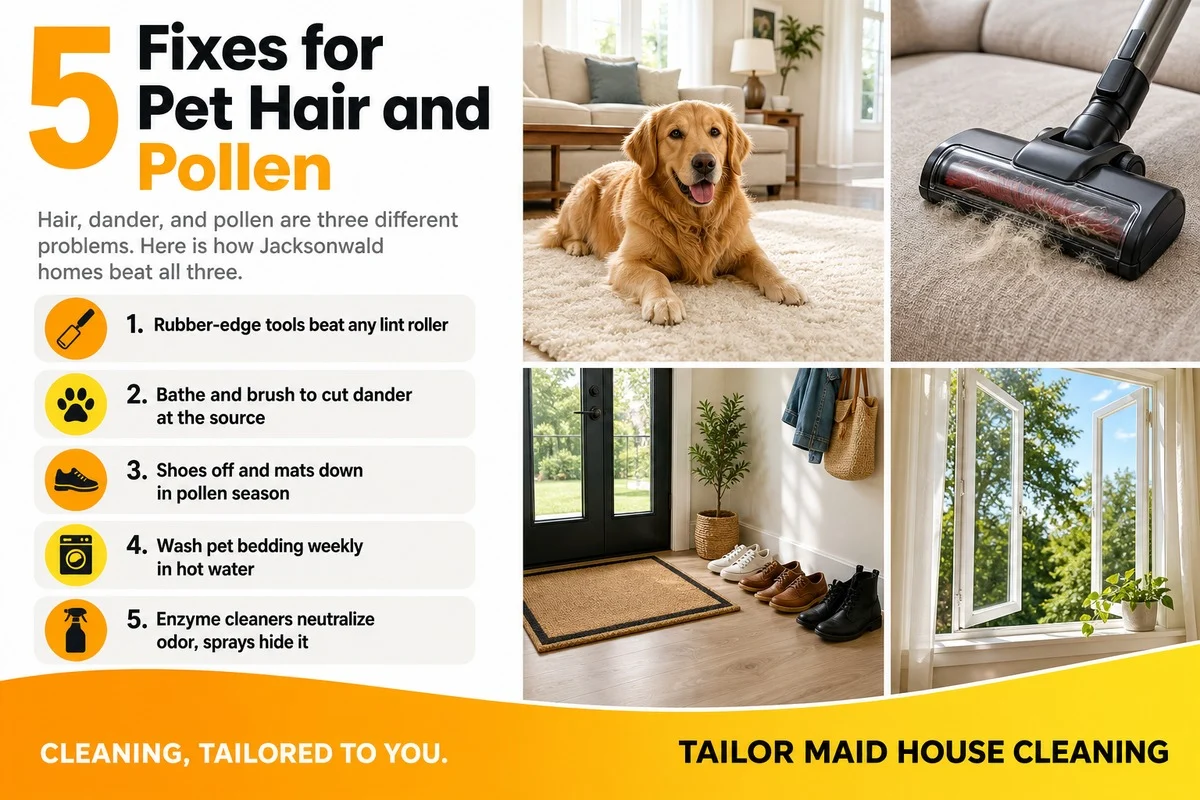
- Rubber-bristle broom on hard floors. A rubber broom generates light static and pulls hair into tidy clumps instead of scattering it the way straw bristles do. On tile and vinyl it beats vacuuming for speed.
- Slightly damp microfiber on baseboards and stair risers. Hair and dander concentrate here because of airflow along walls. Dry dusting sends it airborne; damp cloth captures it.
- Rubber glove trick on upholstery. Put on a dish glove, dampen the palm, and drag it across the couch. Hair rolls up into a rope you can lift off. Faster than a lint roller and free.
- Squeegee on carpet. For hair genuinely woven into carpet pile, drag a window squeegee across it in short strokes. It lifts what your vacuum drives past. Do a small section and you’ll be surprised — and mildly horrified.
- Beat the cushions outside. Twice a month, take removable cushions to the porch and give them a firm smack. You’ll release embedded hair and dust the vacuum can’t reach.
Vacuum technique matters too. Slow, overlapping passes in two directions do far more than fast passes in one. Empty the canister when it’s about two-thirds full — a packed canister loses suction long before it looks full. And clean the brush roll monthly; wrapped hair on the roller is the most common reason a vacuum “stopped working well.”
Reducing Dander at the Source
Cleaning is downstream of a few habits that reduce how much dander enters the room in the first place.
- Brush pets outside. Five minutes on the porch two or three times a week removes loose hair and dander before it lands on your floors. This is the highest-leverage change most pet owners can make.
- Wash pet bedding weekly in hot water. Pet beds are dander reservoirs. Choose beds with removable, washable covers; if the cover won’t come off, you’ll skip it, and it’ll stay dirty.
- Upgrade and change HVAC filters. A pleated filter in the MERV 8–13 range captures far more dander than a cheap fiberglass panel. In a pet household, change it every 60 days, not annually. Check your system’s tolerance before jumping to the highest MERV rating.
- Keep one pet-free room. Usually the bedroom of whoever is most sensitive. It gives the immune system a nightly break, and it’s more effective than any air purifier.
- Wipe paws at the door. A damp cloth or pet wipe after walks near Antietam Lake or the Neversink trails intercepts a startling amount of pollen and dirt.
The August Through October Pollen Plan for Exeter Township
Ragweed season in southeastern Pennsylvania typically starts around the third week of August, peaks in September, and doesn’t fully end until frost. Mold spores from damp leaves peak in October. Here’s the seasonal adjustment we recommend for Jacksonwald homes:
- Close windows during the day. Pollen counts peak mid-morning through early afternoon. If you like fresh air, open windows in the evening instead.
- Create a landing zone. A washable mat outside and a second one inside the door, plus a basket for shoes. Shoes-off households track in dramatically less pollen. A hook for the dog’s towel makes paw-wiping actually happen.
- Wipe window sills and screens weekly. Sills are where pollen accumulates most visibly. Screens hold it and re-release it every time a breeze comes through — a soft brush and a rinse with the hose helps.
- Damp-dust, don’t dry-dust. Through allergy season, use a barely damp microfiber on every hard surface. Feather dusters just resuspend the allergens you’re trying to remove.
- Change bedding weekly and shower before bed. Pollen in your hair transfers to the pillowcase and you breathe it all night. This one change often makes the biggest difference for people who wake up congested.
- Deal with leaves outside promptly. Wet leaf piles against the foundation are a mold-spore factory and the spores come inside on shoes.
Air Filtration: What Helps and What’s Marketing
Air purifiers get oversold, but in a pet household one placed correctly does help. What matters is a true HEPA filter and a unit rated for the square footage of the room it’s in — a small purifier in a large open living area accomplishes very little. Put it where the pets actually spend time, keep it running rather than cycling it on occasionally, and replace filters on schedule; a loaded filter is just an expensive fan.
What doesn’t help: ozone generators, which the EPA cautions against for occupied spaces, and scented filter add-ons that mask odor rather than removing particles. And no purifier substitutes for the basics — vacuuming with sealed filtration, washing pet bedding, and keeping HVAC filters fresh do more for dander levels than any countertop appliance.
Odor: Neutralize It, Don’t Cover It
Pet odor is almost always organic residue that’s still present — not “air that needs freshening.” Fragrance sprays add a second smell on top of the first.
For accidents on carpet or upholstery, an enzyme cleaner is the correct tool. Enzymes break down the uric acid crystals in urine that ordinary detergents leave behind — those crystals reactivate with humidity, which is why a spot that seemed clean in April smells again in August. Blot, don’t scrub; apply the enzyme generously enough to reach as deep as the accident did; and let it dwell for the time on the label. Skip steam heat on urine spots, since heat can set the proteins.
For general background odor, the fix is usually washing textiles: pet beds, throw blankets, slipcovers, and the rug by the back door. Hard surfaces rarely hold odor. Fabric almost always does.
What a Cleaning Company in Jacksonwald Should Do for Pet Households
Pet homes need a different visit structure, not just more elbow grease. When our team cleans a pet household, we plan for it: rubber-broom passes on hard floors, damp microfiber on baseboards and stair edges, cushion and under-cushion attention, entry-zone focus during pollen season, and HVAC filter reminders on a schedule. We also ask which products you’d prefer around your animals, and we can work with fragrance-free, low-residue options.
Honest advice: no cleaning service can make a shedding-season Golden Retriever household look like a home with no pets. What good, consistent cleaning does is reset the baseline every visit so you’re maintaining rather than digging out — and that difference is what people actually notice.
DIY Versus Professional Help
If you’ve got one short-haired pet and a decent vacuum, the routine above is very manageable on your own. Reach out for help when you have multiple pets or heavy shedding breeds, when someone in the house has allergies or asthma that get worse indoors, when you need a seasonal reset before hosting or before allergy season, or when you’re moving out of a rental and need pet evidence gone completely.
You Get Your Time Back
Tailor Maid House Cleaning is a family-owned service in Shillington, run by Jeff and Linda Novotny, with insured and background-checked cleaners who tailor every visit to the home — pets, allergies, preferences and all.
Learn how we serve Jacksonwald and the rest of Exeter Township, explore our cleaning services, or see every community we serve throughout Berks County.
Spend the season outside with your dog instead of chasing hair. Request a free quote or call (610) 775-4048.
Share this article
Related Posts




A quick overview of the topics covered in this article.