Cleaning Older Homes in West Wyomissing: A Pro Guide
West Wyomissing is one of those neighborhoods where the houses have real character. Solid brick and stucco twins, deep front porches, oak floors, plaster walls, cast-iron radiators under the windows, and the kind of trim detail nobody builds anymore. Many of these homes went up between the 1910s and the 1950s, when Wyomissing was growing around the Textile Machine Works and Berkshire Knitting Mills.
Character comes with quirks. Cleaning an older home the way you’d clean a 2015 build is how finishes get ruined — and it’s also why some rooms never feel truly clean no matter how long you spend on them. Older houses hold dust differently, they move air differently, and their surfaces are often original and irreplaceable.
Here’s how we approach vintage homes in West Wyomissing, West Lawn, and the older streets around Reading — and what you can do yourself.
Start With Where the Dust Actually Lives
In a newer, tightly sealed house, most dust arrives on shoes and clothing. In an older home, it also comes from inside the structure: settled dust in wall cavities, aging insulation, plaster grit, unsealed basement floors, and gaps around old window frames and baseboards.
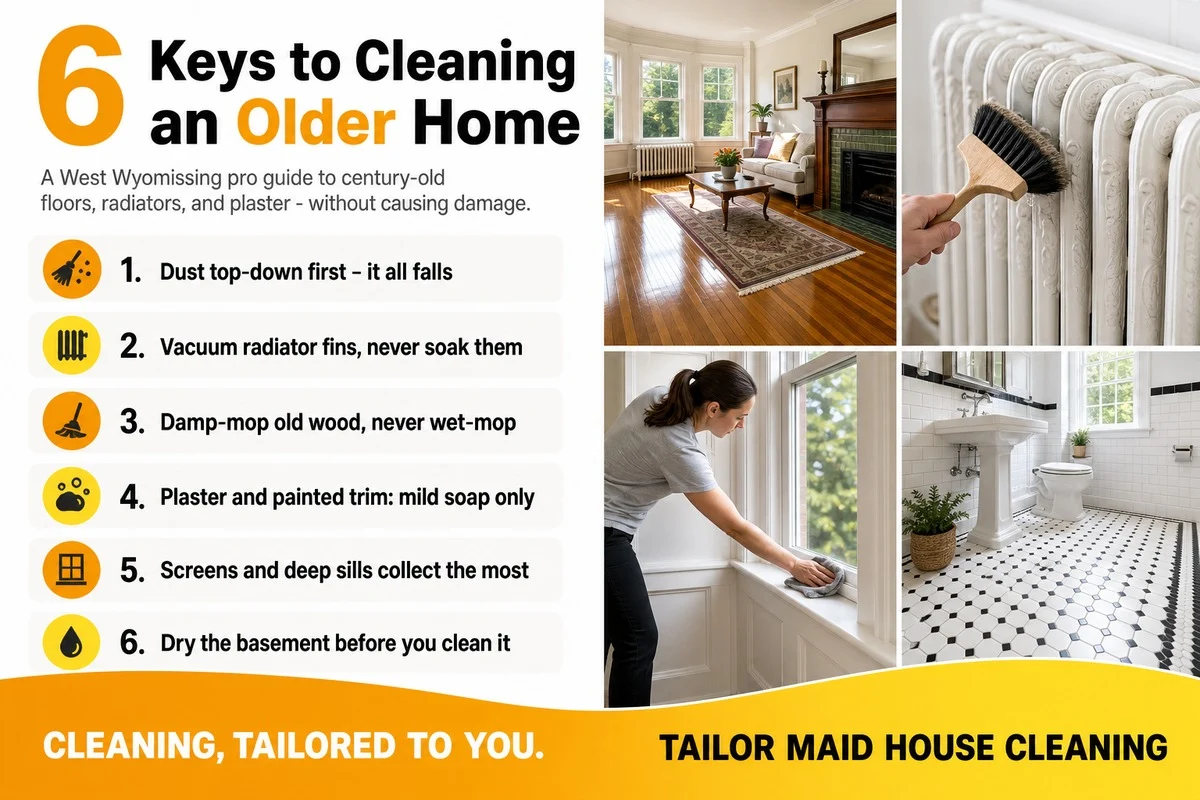
That changes the order of operations. Dust always travels downward, so work top to bottom:
- Ceiling and crown moulding first. Older plaster ceilings hold a surprising amount of fine dust, especially near heat sources. A microfiber duster on an extension pole, dry, in long straight passes.
- Then picture rails, door casings, and window trim. Deep vintage profiles have flat ledges that collect grit. Damp-wipe rather than dry-dust here so you’re lifting rather than launching it.
- Radiators next. More on those below — but they must come before the floor.
- Baseboards, then floors, last. Vacuum before you damp-mop, always.
One tool upgrade matters more in old houses than anywhere else: a vacuum with a sealed HEPA filtration system. Older machines and bagless units without proper sealing exhaust fine dust straight back into the room, which is why a house can feel dustier an hour after you vacuum. The EPA’s indoor air quality guidance emphasizes source control and effective filtration over masking odors, and in a 90-year-old home that advice pays off immediately.
Cast-Iron Radiators: The Job Everyone Skips
Radiators are the single most neglected surface in older West Wyomissing homes, and they matter for two reasons. Dust that settles between the fins bakes when the heat comes on in October, which creates that scorched-dust smell every fall. And a dusty radiator transfers heat measurably less efficiently.
Late summer is the ideal time to do this, before the boiler fires up. Our method:
- Lay an old towel on the floor along the radiator to catch fallout.
- Vacuum the accessible surfaces with a brush attachment, then a crevice tool between the fins.
- For the deep interior, use a radiator brush — a long flexible wand — or slide a microfiber cloth over a yardstick and run it down between sections.
- Finish with a slightly damp cloth on the outer fins. If the radiator is painted, avoid soaking it; older enamel and any metallic radiator paint can lift.
- Vacuum the towel and the floor beneath.
Do this once a year and the fall dust smell largely disappears.
Hardwood Floors That Are Older Than You Are
Original oak and pine floors in these homes may be nearly a century old, and the finish on them tells you how to clean them. Most vintage floors carry either a modern polyurethane recoat or an older penetrating oil/wax finish. Water is the enemy of both, but especially the second.
What works:
- Vacuum or dry-mop first, every time. Grit dragged around under a wet mop is what dulls old floors.
- Barely damp, never wet. A microfiber flat mop wrung out until it feels almost dry. Standing water seeps into seams, swells the wood, and lifts the finish at the board edges.
- pH-neutral wood cleaner only. Vinegar is popular online and it’s a poor choice on wood — acid dulls polyurethane over time and strips wax finishes outright. Skip ammonia, oil soaps, and “mop and shine” products that leave a film that later prevents recoating.
- Test in a closet. If a damp cloth picks up a hazy residue, you likely have a wax finish; stick to dry methods and a wax-specific product.
Squeaks and gaps are normal in old floors and not a cleaning problem. Filling gaps with debris-trapping caulk is not the answer — a good crevice tool is.
Plaster Walls, Painted Woodwork, and Original Tile
Plaster is not drywall. It’s harder, but its paint layers are often chalky, and aggressive scrubbing burnishes a shiny patch you can’t undo. Use the gentlest thing that works: a barely damp microfiber, a drop of dish soap in warm water for scuffs, and light pressure. Test any degreaser on an inconspicuous area first — kitchens in older homes often have decades of layered oil-based paint that reacts unpredictably.
Original hexagon and subway tile in vintage bathrooms usually cleans up beautifully, but the grout is the weak point. Old grout is porous and often unsealed, so it absorbs whatever you leave sitting on it. Bleach whitens it temporarily and erodes it over time. A gentler approach: a baking-soda paste, a soft brush along the grout lines, thorough rinsing, and a grout sealer once it’s fully dry.
One safety point specific to homes of this era. Any house built before 1978 may contain lead-based paint under later layers, and dry-sanding or aggressive scraping of old paint creates hazardous dust. The EPA’s lead safety guidance recommends wet methods and keeping painted surfaces intact. In practice, that means: if paint is chipping, don’t sand it as part of “cleaning” — wet-wipe the area, contain the debris, and get proper advice before disturbing more.
Screens, Storm Windows, and Deep Sills
Older West Wyomissing homes usually have generous window openings with deep wooden sills, plus screens or storm windows that swap seasonally. Those sills are magnets for pollen, insect debris, and the fine grit that works through older sashes.
Vacuum the sill and the track with a crevice tool before introducing any moisture — wet grit in an old wooden track becomes a paste that stains. Then damp-wipe with mild soapy water and dry immediately, because water sitting in a wooden sill joint is how paint fails and rot starts. Screens come out and get a soft brush plus a hose rinse outside, standing them upright to dry so water doesn’t pool in the frame corners. If sash cords or hardware are painted over, leave them alone and note it for a carpenter rather than forcing anything; original weight-and-pulley windows are worth preserving.
Basements, Damp Air, and August in Berks County
Older West Wyomissing homes typically have stone or block basements, and Pennsylvania’s humid summers push moisture through them. High humidity is what turns a musty basement into a mold problem, and it also carries odor up through the house.
What actually helps:
- Keep basement relative humidity near 50% with a dehumidifier that drains to a floor drain, and clean the unit’s coils and bucket — a dirty dehumidifier becomes the smell.
- Store boxes off the concrete on shelves or pallets; cardboard on a damp slab wicks moisture and feeds mildew.
- Address small surface mold promptly following EPA mold cleanup guidance, and treat anything beyond roughly ten square feet, or any recurring patch, as a moisture problem to fix rather than a stain to scrub.
- Run bathroom exhaust fans for 20 minutes after showers. Many homes here have undersized or vent-into-the-attic fans, which relocates the problem instead of solving it.
What a Maid Service in West Wyomissing Should Bring to an Older Home
The honest difference between a good clean and a damaging one in a vintage house is knowing what not to use. When our team takes on an older home, the first visit is partly a walkthrough: identifying finish types, noting original surfaces, flagging anything fragile, and agreeing on what gets touched and what doesn’t. We’d rather ask about an unusual floor finish than guess.
We also plan around the rhythm of these houses — radiators in late summer, storm windows and screens in spring and fall, basement humidity checks through July and August, and porch and entryway attention year-round, because a covered porch collects pollen and dust that walks straight in.
DIY or Call for Help?
Plenty of this you can handle. Weekly dusting top to bottom, damp-mopping properly, and running a dehumidifier will keep an older home in good shape. Consider professional help when your radiators haven’t been cleaned in years, when you’ve inherited or purchased a home and want a true reset before you move furniture in, when mobility makes ladders and floor work unsafe, or when your time is simply worth more spent elsewhere.
Cleaning, Tailored to Your Home
Tailor Maid House Cleaning is family-owned, based right up the road in Shillington, and led by Jeff and Linda Novotny. Our cleaners are insured and background-checked, and we tailor every visit to the home in front of us — which matters a great deal when that home has plaster, oak, and cast iron in it.
See how we serve West Wyomissing and neighboring Wyomissing, browse our cleaning services, or see every community we cover across Berks County.
Ready to reclaim your weekend? Request a free quote or call (610) 775-4048.
Share this article
Related Posts








A quick overview of the topics covered in this article.